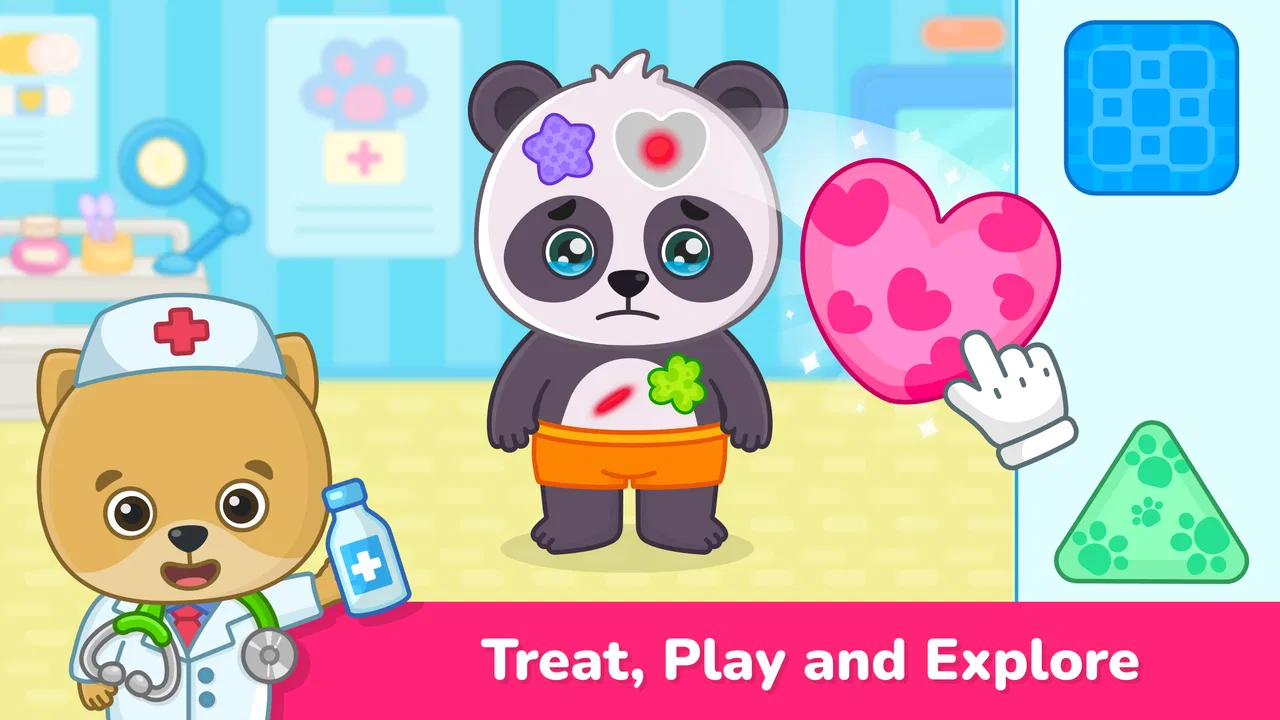
Kids doctor games 2-5 year old
- 4.5
- Rating
- 1.00M
- Installs
- Free
- Price

 Analysis by App-foxy
I spent time with Kids doctor games 2-5 year old as a simple hospital role-play game for young children, and my first impression was that it aims for a calm, approachable kind of learning rather than a competitive challenge. The idea is easy to understand: children can explore doctor-themed activities while practicing attention, recognition, and basic problem-solving. That makes it more suitable for a short shared activity than for a child who wants a deep game with long-term progression.
The game is made by Bimi Boo Kids Learning Games for Toddlers FZ-LLC and is listed as a free educational game for Everyone. It is designed around preschoolers, especially children in the two-to-five-year range suggested by its title, although the store summary places its main audience around ages three to four. I would treat those age references as a useful guide rather than a strict rule, because children develop at very different speeds.
What makes this particular game worth considering is the familiar setting. A hospital and doctor scenario gives a child a clear reason to interact with the screen. Instead of presenting learning as a worksheet, it turns the activity into pretend play. The strongest part of the experience is its low-pressure invitation to explore a role that children already recognize.
You May Also Like

 Blood Strike: 2.5 Anniversary
Blood Strike’s Loadouts Turn Every Drop Into a Tactical Gamble
A close look at Blood Strike’s custom loadouts: how fast access to signature weapons reshapes its battle royale rhythm, rewards preparation, and narrows the gap between fights.

 Pandora - Music & Podcasts
Pandora’s Music Is Easy to Start, but Harder to Recover
Pandora’s strength is its low-effort path from a seed to a station. Its weak spot is how much confidence it asks you to place in connection, setup, and quiet recovery.

 8 Ball Pool
 Is Built on Rivalries, Rematches, and Routine
A close look at the rivalries, rematches, shared routines, and unanswered safety questions that turn a quick pool match into a persistent mobile community.

 Samsung Music
’s Quiet Strength Is Playing What You Already Own
Its reach comes less from spectacle than from dependable access to a personal library. That simplicity is both the app’s strongest retention engine and its ceiling.

 AccuWeather: Weather Radar
AccuWeather Review: A Quick, Clear Forecast for Everyday Decisions
For everyday plans, the best forecast is the one you can understand quickly. AccuWeather makes rain timing, radar, and local conditions easy to act on, with a few trade-offs.

 Hill Climb Racing
Why Hill Climb Racing Still Turns Crashes Into One More Run
A tiny car, a bumpy hill and one more upgrade: Hill Climb Racing keeps resurfacing because its simple chaos makes every near-miss feel personal.
More From Our News Desk



How clearly the game communicates with young players
I see clear communication as more than a child finding the right picture: it also means knowing what to do next without feeling tested. When I play alongside a preschooler, I would watch for moments of hesitation and use a brief spoken cue rather than taking over the screen. That small distinction helps me judge whether the game is supporting the child’s own understanding, which leads into the question of how its play can be adapted to different needs and routines.
Readability and navigation for preschool use
For a preschool game, visual clarity matters more than a large number of options. A child who is still learning to follow instructions should not have to understand complicated menus before reaching the main activity. In my view, the doctor theme gives the game a useful advantage because the setting itself helps explain what is happening. Medical objects, rooms, and actions are easier for many children to connect with than abstract educational symbols.
I would introduce it while sitting beside the child the first time. That is not a criticism unique to this game; young children often need an adult to explain what a button or picture does, even when the design is friendly. After that first guided session, a child who is comfortable with touch screens may be able to recognize the central choices independently. The important test is not whether a child can use every part alone, but whether the game gives enough visual context to make the next action understandable.
The interface is best judged from a child’s perspective rather than an adult’s. Preschoolers may not read instructions fluently, so recognizable images and short action sequences are more useful than text-heavy explanations. Parents should watch whether their child understands the visual cues without repeatedly asking what to do. If the child spends more time searching for controls than engaging with the pretend-play task, the game is probably not a good independent activity yet.
One practical tip is to begin with a short session when the child is rested. If the child is already tired, even a clear game can feel confusing. I found that role-play works better when I describe the activity in ordinary language, such as “Let’s help the patient,” rather than turning it into a test. That keeps the focus on participation and reduces the pressure to perform correctly.
Supporting different ways of understanding
Children do not all process information in the same way. Some respond quickly to pictures, while others need an adult to narrate each step. A hospital game can support both approaches when the adult uses it flexibly: one child may tap and discover, another may benefit from hearing the purpose of each action before touching the screen.
I also think the game is more useful as a conversation starter than as a replacement for real-world learning. After a session, I might ask what a doctor does, why a patient visits a hospital, or which object the child remembers. These questions extend the activity without making the app responsible for teaching every concept by itself. The game provides a setting; the parent or educator supplies the broader context.
That distinction matters for children with emerging language skills. A child can still participate through pointing, tapping, and watching, even if they cannot name every object. At the same time, the game should not be treated as a complete communication tool. If a child needs highly individualized symbols, visual schedules, or a specific alternative communication system, a dedicated support app or specialist-selected resource may be a better choice.
What the hospital theme adds
The medical setting gives ordinary actions a narrative purpose. In a general puzzle game, matching or selecting an object can feel disconnected. Here, the same kind of interaction can be framed as helping someone. That small change may make the activity more meaningful for a child who enjoys pretend play.
There is also a useful emotional opportunity. Some children are curious about doctors, while others feel nervous about hospitals. Playing a gentle doctor scenario at home can give parents a way to talk about appointments before one happens. I would not promise that it will remove fear, but it can help a child rehearse familiar ideas in a controlled setting. If the child becomes more worried rather than more comfortable, I would stop and choose a different theme.
Using it across different abilities and everyday situations
I would treat flexibility as something the adult brings to the session: the same hospital role-play can be a quick turn-taking activity, a chance to name familiar objects, or a gentle conversation before an appointment. Keeping the session short and letting the child pause or stop makes it easier to fit around attention, comfort, and motor needs. Those practical choices matter when deciding whether this game suits a particular child and setting.
Motor and sensory considerations
Touch interaction can be inviting for children who are still developing hand control, but it can also be demanding. A young child may tap too lightly, press in the wrong place, or drag with an uneven movement. I would give the child time to try before correcting them. Immediate adult intervention can turn a playful activity into a demonstration where the child only watches.
A useful approach is to place the device on a stable surface rather than expecting a child to hold it throughout the session. This can reduce accidental movement and make tapping easier. It also lets the child use one finger at a time without balancing the device. The setup is especially helpful for children who fatigue quickly or who find precise touch actions difficult.
Parents should also observe the sensory environment around the game. Screen brightness, sound, room lighting, and background noise can affect whether a child can concentrate. A quieter room may help a child who is easily distracted, while a child who enjoys spoken interaction may benefit from an adult commenting on what is happening. These adjustments come from the surrounding routine, not from any assumption that the app offers specialized sensory controls.
For children with limited fine-motor control, the key question is whether the game remains enjoyable when accuracy is inconsistent. If missed taps repeatedly interrupt the activity, an adult can try larger device positioning, slower pacing, or hand-over-hand support for a moment. However, the adult should gradually reduce help so the child retains a sense of control. If the child cannot interact comfortably even with those changes, a game built specifically around simpler gestures may be more appropriate.
Visual access deserves the same practical attention. Some children may need the device closer, while others may find a close screen uncomfortable. I would avoid assuming that bright colors or large illustrations automatically make an app accessible. The real test is whether the individual child can distinguish the important objects and follow the activity without strain.
Situational access at home and on the move
This game makes the most sense in short, supervised moments: before dinner, during a quiet afternoon, or while a parent is preparing for a medical appointment. It can offer a focused alternative to fast entertainment because the role-play theme gives the child something specific to do. I would use it as one activity in a routine, not as an all-purpose way to occupy a child.
A realistic example would be a preschooler who has an appointment the following morning. A parent could play alongside the child, talk about waiting rooms and healthcare workers in age-appropriate terms, and let the child lead the pretend scenario. The parent can then notice which parts seem familiar and which create confusion. That information may help the adult explain the real visit more clearly, although the game should not be presented as an exact preview of a particular clinic.
It can also work for siblings with different levels of confidence. An older preschooler may take the lead while a younger child points to objects or watches. To keep this fair, I would give each child a turn rather than allowing the more experienced player to control the whole session. The game is more inclusive when participation is not measured only by speed or independence.
For travel, the free entry point is convenient because a family can try the experience without committing to a purchase first. Still, I would test it at home before relying on it during a journey. A child may enjoy it in a quiet room but lose interest in a busy car, waiting area, or airport. Parents should also remember that a game can be useful during a transition without becoming the only way the child copes with waiting.
The app runs on Android devices using version 7.0 or later, which covers a broad range of compatible phones and tablets. The current version is 1.4. I would still check the device personally before giving it to a child, because compatibility on paper does not guarantee that the screen size, touch response, or performance will feel comfortable for that particular child.
Where it fits among other preschool choices
Compared with alphabet, counting, or early-writing apps, this game has a narrower educational identity. It is not the first choice for a parent who wants systematic practice in letters or numbers. Its value comes from pretend play, familiar situations, and the chance to connect actions with a social role.
Compared with open-ended drawing apps, it offers more direction. That can help a child who feels lost when given a blank canvas, but it may frustrate a child who wants complete creative freedom. Compared with fast arcade-style children’s games, the hospital setting feels more purposeful and less dependent on reflexes. The trade-off is that children who need constant novelty may find the experience limited sooner.
I would choose this game over a generic puzzle when the child is interested in doctors, clinics, or caring for others. I would choose a different educational app when the immediate goal is structured literacy, numeracy, music, or a highly customized accessibility setup. The right comparison is not “Which game is best?” but “What does this child need from the next ten minutes?”
Remaining barriers and points parents should watch
The free label makes the initial decision easier, but the game includes in-app purchases priced at $4.99 per item. Parents should manage purchasing access before handing over the device. A child may understand how to tap attractive options without understanding that a purchase has consequences. I would review the available content with the adult account first and decide whether the free portion is enough for your family.
Another limitation is the age range itself. A child near the younger end may need much more guidance, while an older child may complete the activities quickly and ask for more complexity. The store’s Everyone rating indicates broad content suitability, but it does not mean every child will find the interaction equally comfortable or engaging. Developmental level matters more than the label alone.
Parents should also avoid using the game as a substitute for medical explanations from a trusted adult or healthcare professional. It can support pretend play and conversation, but it cannot answer a child’s personal health questions or prepare them for every real procedure. If the child is anxious about an upcoming appointment, combine play with simple, honest explanations rather than relying on the app to do all the preparation.
Independence is another area where expectations need to stay realistic. Some children may navigate confidently after an introduction; others may need an adult nearby every time. That is not necessarily a failure. Shared play can be the most valuable format, especially for children who benefit from spoken language, encouragement, or help with touch accuracy.
I would skip this game for a child who strongly dislikes medical themes, becomes distressed by pretend patient scenarios, or needs advanced accessibility options that are not part of the ordinary interface. I would also look elsewhere for children who want complex stories, competitive rewards, or a clear curriculum with measurable lessons. The game’s focused simplicity is a strength for some families and a limitation for others.
An inclusive verdict for families
After using it, I see Kids doctor games 2-5 year old as a gentle, theme-led option for preschool children who enjoy imitation and helping roles. Its clearest benefit is that it gives early learning a recognizable setting. The child is not simply completing an abstract task; they are taking part in a small doctor-themed scenario that an adult can expand through conversation.
The game has also attracted a substantial audience, with over 500 thousand installs and a 4.3 average from around 6 thousand ratings. Those figures suggest that many families have found the concept appealing, but they should not replace observing your own child’s response. A popular preschool game can still be the wrong match for a child who needs slower interactions, different sensory conditions, or a more structured subject.
My recommendation is to try it first as a shared activity. Sit close enough to notice whether the child can identify the next action, whether touch movements feel manageable, and whether the hospital theme creates curiosity or discomfort. Adjust the room, device position, and pace before deciding that the game does or does not work. Those small changes often reveal more than a quick first impression.
For families looking for educational doctor games that encourage pretend play rather than formal lessons, this is a sensible free starting point. I would keep expectations modest: it is a focused preschool game, not a complete early-learning program and not a specialized accessibility tool. Used in the right setting, especially with an adult who talks and plays alongside the child, it can turn a few quiet minutes into a friendly opportunity to explore care, health, and everyday roles.
Overall, I would recommend it to parents of young children who enjoy doctor play and benefit from visual, hands-on activities. I would be more cautious for children who need extensive individual accommodations or who are ready for deeper educational challenges. Its inclusive potential comes less from claiming to suit everyone and more from allowing adults to adapt the pace, language, and setting around the child. That makes it a worthwhile option, provided the family treats it as a flexible play experience rather than a one-size-fits-all lesson.
FAQs for Kids doctor games 2-5 year old
01What age group is Kids Doctor Games designed for?
Kids Doctor Games is designed specifically for children aged 2 to 5 years old. The app includes age-appropriate activities that are both entertaining and educational, helping young kids learn through play. It's tailored to suit the developmental needs of toddlers and preschoolers, ensuring a safe and engaging environment.
02Are there any in-app purchases or ads in Kids Doctor Games?
Kids Doctor Games typically offers a mix of free content and additional features available through in-app purchases. While the basic version is fun and engaging, some premium content might require a purchase. It's important to check whether the app contains ads, as this varies across versions and platforms.
03How does Kids Doctor Games support my child's learning?
Kids Doctor Games supports learning by offering interactive scenarios where children can role-play as doctors. This not only enhances cognitive skills through problem-solving but also improves fine motor skills. The app often incorporates elements of color recognition, counting, and basic anatomy to foster educational growth.
04Is Kids Doctor Games safe for my child to use?
Yes, Kids Doctor Games is designed with safety in mind, featuring a child-friendly interface and content appropriate for young children. The app does not include any violent or inappropriate material, ensuring a safe digital space. However, parental guidance is recommended to monitor screen time and usage.
05Can Kids Doctor Games be used offline?
Kids Doctor Games can often be used offline, allowing children to enjoy the app without an internet connection. This feature is particularly useful for travel or in areas with limited connectivity. However, initial downloads and updates may require internet access, so it's best to check the specific requirements of the app.
Pros
- Engaging and educational gameplay.
- Bright and colorful graphics.
- Simple controls for young kids.
- Promotes creativity and empathy.
- No in-app purchases required.
Cons
- Limited variety of mini-games.
- Repetitive music can be annoying.
- Requires internet for some features.
- Ads may interrupt gameplay.
- Not challenging for older kids.

Kids doctor games 2-5 year old
Gallery